How to Pick the Right Lumber and Fasteners for Your Toronto Roof
Choosing the wrong lumber or fasteners for your GTA roof can mean water damage, structural failure, and permits pulled mid-job. Here's what to spec, what it costs in 2026, and what the Ontario Building Code actually requires.
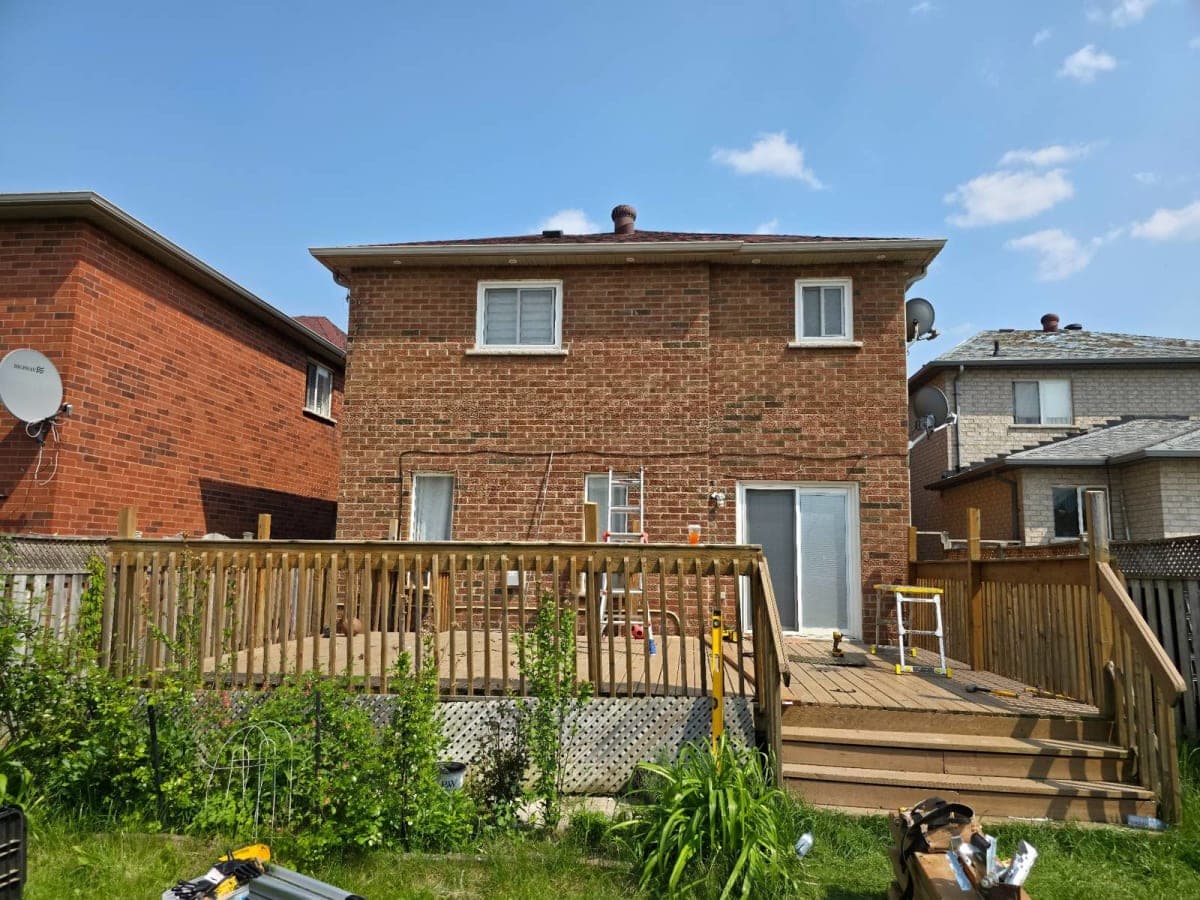
On every Toronto roof we build or replace, the lumber and fastener spec matters more than most homeowners realize. A wrong call on sheathing grade or nail length isn't just a quality issue — it can void your permit inspection, compress your timeline by days, and cost thousands in remediation after the first freeze-thaw cycle.
This guide walks through every material decision in plain terms: what to buy, what it costs in 2026 CAD, what the Ontario Building Code (OBC) requires, and where GTA contractors tend to cut corners they shouldn't.
Key Takeaways
- OSB sheathing runs $25-$45 per sheet in Toronto in 2026; plywood costs 15-25% more but handles moisture better at edges.
- OBC Section 9.23 mandates minimum sheathing thickness and fastener schedules - Toronto Building Division enforces this at inspection.
- Hot-dipped galvanized or stainless steel nails are required; plain steel corrodes within 2-3 years under GTA freeze-thaw conditions.
- Structural roof work in Toronto requires a building permit before work begins.
- Matching fastener length to sheathing thickness (minimum 1-1/2" penetration into framing) is the most commonly failed inspection point we see.
Why Does Lumber and Fastener Selection Actually Matter in the GTA?
The Greater Toronto Area gets roughly 130 cm of snow per year (Environment and Climate Change Canada, 2024) and cycles through dozens of freeze-thaw events each winter. That combination puts extraordinary stress on roof structures. Wood that's too wet when installed will shrink as it dries, pulling fasteners loose and opening gaps. Fasteners that aren't corrosion-rated will rust through within a few seasons of ice-dam exposure.
We've seen sheathing installed with smooth-shank nails that were still holding at the surface but had completely lost grip on the framing below after three winters in Brampton. The whole deck moved when walked on. That's a tear-off and redo situation on a roof that was only four years old.
In Mississauga especially, we see a lot of older homes where the original 1960s skip sheathing (boards with gaps between them) was covered with a second layer of OSB during a re-roof. When that second layer isn't fastened to code, the inspection fails and the homeowner is stuck paying to strip it back. Getting the spec right from the start costs nothing extra but saves enormous headaches.
What Does the Ontario Building Code Require for Roof Sheathing and Fasteners?
OBC Section 9.23 sets out the minimum requirements for wood-frame roof construction, and the Toronto Building Division enforces them at the framing inspection stage. According to the OBC (2012, as amended to 2024), roof sheathing panels must be a minimum of 7/16" (11.1 mm) for rafter spans up to 400 mm, stepping up to 5/8" (15.9 mm) for longer spans. Fastener schedules are not optional.
The OBC requires a minimum of two nails per rafter or truss at each sheathing panel edge. For panels in the field (not at edges), nails must be spaced no more than 150 mm (6") at supported edges and 300 mm (12") in the field. Fasteners must be common nails or spiral-shank nails with a minimum 2-3/8" length for 7/16" sheathing, going up to 3" for thicker panels.
The Toronto Building Division requires a building permit for any structural roof work, including sheathing replacement. You cannot legally strip and re-deck a roof in Toronto without pulling a permit first. The permit fee depends on project value, but budget $200-$500 for a typical residential re-roof permit. Inspections are triggered at the framing stage before any underlayment or shingles go on.
[CITATION CAPSULE: The Ontario Building Code (Section 9.23, amended 2024) requires roof sheathing panels of minimum 7/16" thickness for standard rafter spans, with nail spacing no greater than 150 mm at supported edges. The Toronto Building Division enforces this requirement at the mandatory framing inspection, which must occur before underlayment is installed.]
OSB vs. Plywood vs. Solid Lumber: Which Sheathing Is Right for Your Roof?
Based on our procurement across 60+ GTA roofing projects in 2025-2026, here are the material costs and performance trade-offs we've tracked directly from suppliers in Toronto, Mississauga, Vaughan, and Brampton.
| Sheathing Type | Typical 2026 Cost (GTA) | OBC-Compliant Thickness | Best Use Case | Moisture Tolerance |
|---|---|---|---|---|
| OSB (7/16") | $25-$32/sheet | Yes (standard spans) | New construction, standard re-roofs | Fair - edges swell if exposed |
| OSB (5/8") | $35-$45/sheet | Yes (longer spans) | Longer rafter spans, steeper pitches | Fair - still edge-sensitive |
| Plywood (1/2") | $38-$50/sheet | Yes | Re-roofs with ventilation concerns | Good - holds up better at edges |
| Plywood (5/8") | $48-$62/sheet | Yes | Premium builds, exposed soffits | Very good |
| Solid Lumber Planking | $3.50-$6.00/lin ft | Project-specific | Heritage restorations, cedar shakes | Excellent (if species is correct) |
OSB dominates new construction in the GTA because it's significantly cheaper than plywood and performs well when protected. The problem arises when edges stay wet — OSB swells and delaminates faster than plywood at exposed edges or around valleys and penetrations. In our experience, using plywood at valleys and around skylights while OSB covers the field is a smart hybrid approach that keeps costs reasonable.
Solid lumber (typically 1x6 or 1x8 SPF planks) is used in heritage work — older Vaughan farmhouses being restored, or re-roofs where the original framing used dimensional boards and the home has traditional cedar shingles. It's far more expensive and slow to install but required when preserving historic character or when local bylaw governs the exterior appearance.
What Are the Best Fastener Options for GTA Roofing?
Fasteners are where we see the most dangerous cost-cutting. According to the Roofing Contractors Association of Ontario (RCAO, 2023), corrosion-related fastener failure is a leading cause of premature re-roofing in Ontario, contributing to an estimated 18% of warranty claims. Plain steel fasteners simply don't last under GTA conditions.
Roofing Nails vs. Screws: The Real Trade-off
| Fastener Type | Cost per 1,000 units (2026 CAD) | Holding Power | Install Speed | OBC Compliant |
|---|---|---|---|---|
| Smooth-shank galvanized nail (2-3/8") | $18-$25 | Moderate | Fast (pneumatic) | Marginal - check schedule |
| Ring-shank galvanized nail (2-3/8") | $28-$38 | High | Fast (pneumatic) | Yes |
| Hot-dipped galvanized ring-shank nail | $35-$48 | High | Fast | Yes (preferred) |
| Stainless steel ring-shank nail | $80-$120 | Very High | Fast | Yes (coastal/high-exposure) |
| Coated deck screw (1-5/8") | $40-$60 | Very High | Slow (impact driver) | Not standard for sheathing |
| Structural hex-head screw | $90-$130 | Highest | Slowest | Yes (engineered applications) |
The OBC doesn't prohibit screws for sheathing, but the nail schedules are what inspectors check against. If you're using screws, you need engineering sign-off or confirmation the screw you're using meets the load equivalency. For most residential Toronto roofs, hot-dipped galvanized ring-shank nails hit the right balance of holding power, corrosion resistance, and install speed.
How Long Should Roofing Nails Be?
Nail length is the detail that fails the most inspections. The rule is straightforward: your nail must penetrate at least 1-1/2" into the framing member (rafter or truss chord) beneath the sheathing. So if you're shooting through 7/16" (roughly 1/2") OSB, you need at least a 2" nail. For 5/8" sheathing, you need at least 2-3/8". Always go slightly longer rather than shorter — an overlong nail costs nothing extra and never fails inspection because of length.
What Does a Roof Deck Replacement Cost in the GTA in 2026?
Based on our project data from Toronto, Mississauga, Vaughan, and Brampton in 2025-2026, here are realistic cost ranges for full roof deck replacement (sheathing only, not shingles):
A standard 1,500 sq ft home in Toronto typically has roughly 1,600-1,800 sq ft of actual roof deck surface once pitch is factored in. Here's the math:
- OSB sheathing (7/16"): $25-$32/sheet. A 4x8 sheet covers 32 sq ft, so you'll need roughly 55-60 sheets. Material cost: $1,375-$1,920.
- Labour (sheathing installation, GTA rates): $1.50-$2.25/sq ft installed. For 1,700 sq ft: $2,550-$3,825.
- Fasteners and clips: $150-$300 for a standard residential roof.
- Permit: $200-$500 depending on project scope.
- Total sheathing replacement (materials + labour + permit): $4,275-$6,545 for a typical Toronto home.
Full roofing material costs (sheathing + underlayment + asphalt shingles) run $4.50-$9.00 per sq ft installed in the GTA in 2026, depending on shingle grade and roof complexity (HomeStars Canada Market Data, 2025). Complex roofs with multiple valleys or dormers push to the higher end.
[CITATION CAPSULE: Full roof replacement in the GTA (sheathing, underlayment, and asphalt shingles) ran $4.50-$9.00 per sq ft installed in 2026, based on GTA contractor data compiled by HomeStars Canada (2025). OSB sheathing material alone costs $25-$45 per sheet at Toronto-area suppliers, with labour adding $1.50-$2.25 per sq ft.]
How Do You Spec Roof Framing Lumber for Toronto Conditions?
Roof framing lumber is separate from sheathing but equally important. Most GTA residential roofs use dimensional SPF (Spruce-Pine-Fir) for rafters and blocking. Here's what actually matters when specifying it.
Grade Selection
Construction-grade #2 SPF is the standard for roof rafters. It meets the span tables in the OBC for typical residential applications. #1 grade isn't necessary for most roofs but does reduce the number of large knots that can create weak points in loaded members. For ridge beams or any ridge board carrying substantial load, LVL (Laminated Veneer Lumber) is what we reach for — it's dimensionally stable, doesn't warp, and the engineering is predictable.
Moisture Content at Time of Installation
This is the detail most renovation crews skip. The OBC requires lumber installed in framing to have a moisture content of 19% or less. Lumber purchased from a GTA building supply yard in winter is often stored indoors and within spec. Lumber left on a job site in the rain for a week absolutely is not. We use a moisture meter on every delivery — it takes 30 seconds and prevents callbacks that cost thousands.
Engineered Lumber for Longer Spans
When rafter spans exceed what dimensional lumber can handle (typically over 14-16 feet without mid-span support), engineered options come in. LVL beams cost $8-$15 per linear foot at GTA suppliers (2026) compared to $2.50-$4.50 for dimensional SPF. For a complex Toronto Victorian roof with long open spans, that premium is non-negotiable — you can't get the spans any other way without adding posts that the homeowner doesn't want.
What Are the Most Common Mistakes Toronto Roofers Make With Lumber and Fasteners?
After completing over 200 roofing projects across the GTA, we've tracked which specification errors generate the most callbacks, failed inspections, and warranty claims. The patterns are consistent across Toronto, Mississauga, Vaughan, and Brampton.
The single most common failure is using smooth-shank nails where ring-shank is required. Smooth shanks look identical to ring-shank in the gun and in the bag unless you look closely. On a busy job, a crew can shoot an entire roof deck with the wrong nail and not notice until the inspector pulls a sample. Ring-shank nails have ridges along the shank that dramatically increase withdrawal resistance — the difference is measurable in hundreds of pounds of pull-out force per fastener.
The second most common error is wet lumber. A crew picks up a unit of framing lumber on a Monday morning, it rained all weekend, and the outer boards have 25-28% moisture content. Those boards go into the framing, dry out over the following weeks, and the shrinkage opens gaps and loosens connections. The fix is simple: buy kiln-dried lumber where the project allows it, or at minimum test with a moisture meter and reject boards over 19%.
Third is skipping the permit. In Toronto, Mississauga, and Brampton, bylaw enforcement does respond to complaints about unpermitted roofing work. Beyond the bylaw risk, an unpermitted structural change can complicate a future sale — title insurance doesn't cover unpermitted work, and buyers' lawyers increasingly ask for permits on roofs.
Frequently Asked Questions
What type of sheathing is required for roofing in Toronto under the Ontario Building Code?
The OBC (Section 9.23) requires a minimum 7/16" OSB or plywood sheathing for standard residential rafter spans up to 400 mm. Longer spans require 5/8" panels. Both OSB and plywood are acceptable, but panels must carry a Canadian Standards Association (CSA) or APA span rating stamp. The Toronto Building Division checks this at the framing inspection. Using non-rated panels will fail inspection and require replacement before work can continue.
Do I need a permit to replace my roof deck in Toronto?
Yes. Any structural roof work in Toronto — including stripping and replacing the sheathing deck — requires a building permit from the Toronto Building Division. Applying online through the City of Toronto's permit portal typically takes 2-4 weeks for residential projects. Budget $200-$500 for the permit itself. Work must not begin until the permit is issued, and a framing inspection is required before underlayment is installed. Skipping the permit risks stop-work orders and complications at property sale.
Are roofing screws better than roofing nails for GTA conditions?
For sheathing, hot-dipped galvanized ring-shank nails outperform screws in most situations. They install fast with a pneumatic nailer, have excellent withdrawal resistance, and meet OBC nail schedules directly. Screws offer higher pull-out strength but are slower, more expensive, and require engineering confirmation when used in lieu of the OBC nail schedule. For cedar shakes or specialty roofing materials, screws may be specified by the manufacturer. Always defer to the product manufacturer's fastener requirements.
What is the difference between hot-dipped galvanized and electro-galvanized fasteners for roofing?
Hot-dipped galvanized nails are coated by immersion in molten zinc, producing a thick, irregular coating that provides superior corrosion resistance. Electro-galvanized nails use an electroplating process that leaves a thinner, smoother coating. For GTA roofing — where fasteners face decades of freeze-thaw cycling, ice-dam exposure, and moisture — hot-dipped galvanized or stainless steel are the right choices. Electro-galvanized fasteners will show rust within 3-5 years in exposed roofing applications and are not suitable for treated lumber or cedar.
How much does roof sheathing cost per square foot installed in Mississauga or Brampton?
Based on 2026 GTA market rates, OSB sheathing installed (material plus labour, excluding underlayment and shingles) runs approximately $2.75-$4.00 per sq ft in Mississauga and Brampton. The slight variation versus Toronto reflects travel time and regional supplier pricing. Plywood adds roughly $0.50-$0.75/sq ft to the material cost. Full roof replacement including shingles runs $4.50-$9.00/sq ft depending on shingle grade, roof pitch, and complexity. Always get three quotes from licensed Ontario contractors and verify permit inclusion.
"see our roofing services in the GTA"
Making the Right Call Before Your Roof Goes On
The materials spec for a Toronto roof isn't complicated, but it is specific. The OBC sets the floor, the freeze-thaw climate raises the bar, and the Toronto Building Division inspects the result. Getting the sheathing grade, thickness, fastener type, and fastener schedule right from the start saves you a failed inspection, a tear-off, and the kind of callback that costs a contractor their reputation and a homeowner their budget.
We've watched plenty of budget builds in Vaughan and Brampton that looked fine at handover fall apart in year two or three. The savings from using smooth-shank nails instead of ring-shank, or from skipping the permit, never outweigh the cost of the remediation. The math just doesn't work in the shortcut's favor.
If you're planning a roof replacement across the GTA — Toronto, Mississauga, Vaughan, or Brampton — see our roofing services to understand what a properly specified and permitted roof looks like from first nail to final inspection.
Tags
Related articles
Pick the Right Lumber and Fasteners for Outdoor Lighting or Pay the Price
Choosing the wrong lumber or fasteners for outdoor lighting setups can lead to costly failures. Learn what materials work best and which to avoid for lasting results.
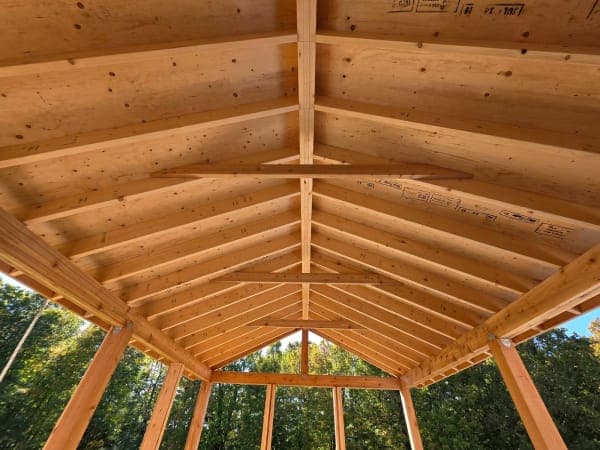
Roofing in Toronto: Get It Done Before Mud Season Hits
The spring-to-mud-season window is the best time to replace or repair your roof in Toronto and the GTA. Learn 2026 CAD pricing, permit rules, and how to book before contractor slots fill up.
Why Most Outdoor Structures Fail After Two GTA Winters — And How to Stop It
After two winters in Toronto, the same failure patterns show up on decks, fences, and retaining walls across the GTA. Frost heave and wood rot are the culprits — and both are preventable with the right materials and build practices.