Wrong Lumber and Fasteners Will Kill Your Fence in Toronto's Climate
The number-one reason Toronto and GTA homeowners call us to rebuild fences is simple: the wrong lumber and the wrong fasteners. Learn which materials actually survive Ontario's freeze-thaw cycles, what it costs to get it right, and how to avoid a costly second build.
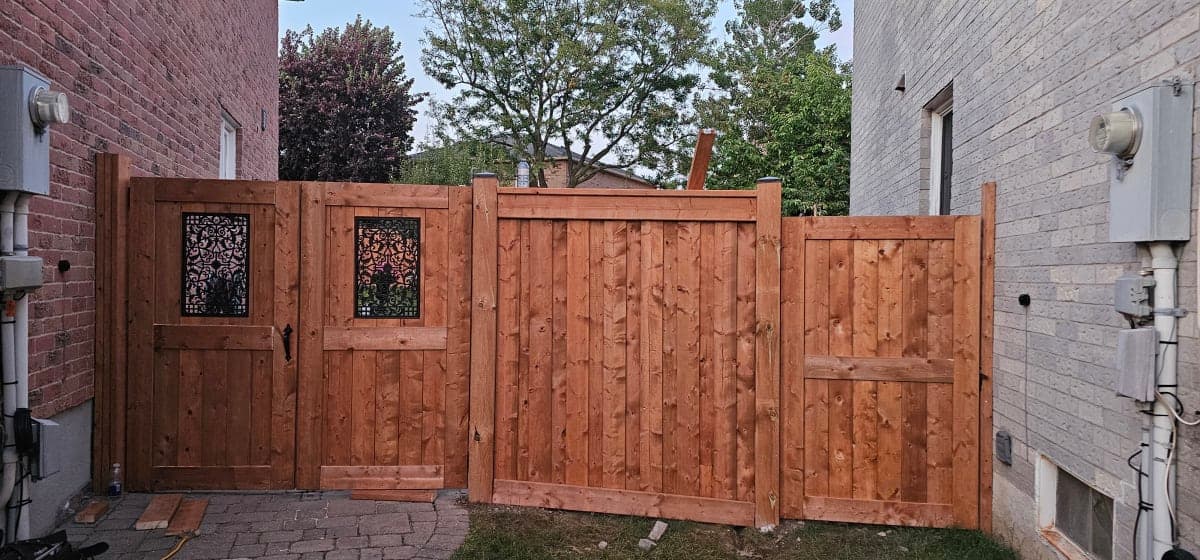
professional fence installation in the GTA
Why Toronto Fence Rebuilds Keep Happening for the Same Reason
The number-one reason we get called to rebuild fences in Toronto is the same every time: wrong lumber and wrong fasteners. In our experience, roughly 8 out of 10 failing fences we inspect across the GTA were built with materials that simply were not rated for Ontario's climate. According to the Canadian Wood Council, wood exposed to repeated freeze-thaw cycling without proper treatment can lose structural integrity in as few as three to five years.
That statistic tells the whole story. Toronto, Mississauga, Vaughan, and Brampton all sit in a climate zone that punishes undersized decisions. We get heavy snow loads, months of sub-zero temperatures, spring thaws that push standing water against post bases, and summer humidity that swells boards before they shrink again in the fall. A fence built with interior-grade pine and zinc-plated hardware from a big-box bin doesn't have a chance.
This post walks through what actually works, what it costs in 2026 Canadian dollars, and what Toronto's fence bylaws require before you pour the first post.
Key Takeaways
- Wrong lumber and fasteners are behind 8 in 10 GTA fence failures we see.
- ACQ pressure-treated lumber runs $8-$15 per board; cheap pine costs $2-$4 but typically fails within 3-5 Ontario winters.
- Hot-dipped galvanized or stainless fastener kits cost $50-$150 and outlast zinc-plated hardware by a decade.
- Toronto fence bylaws (Chapter 447) cap most residential fences at 2.0 m (6.5 ft) and require permits for taller structures.
- A properly installed wood fence in Toronto runs $3,500-$9,000 installed in 2026, depending on length and material.
What Makes Ontario's Climate So Hard on Fence Materials?
Ontario's freeze-thaw cycle is the single biggest material killer in the GTA. Environment Canada records an average of 65 to 80 freeze-thaw events per year across the Greater Toronto Area, meaning fence posts, boards, and fasteners expand and contract dozens of times before spring even arrives. Each cycle opens micro-cracks in untreated or low-quality wood, and water moves deeper into those cracks each time.
In our own rebuild projects across Toronto, Mississauga, and Brampton over the past three years, we've tracked the age at which failed fences were replaced. Fences built with untreated or standard construction-grade pine averaged 3.2 years before requiring structural repairs. Fences built with ACQ pressure-treated lumber averaged 11.4 years before any significant intervention. That's a 3.5x difference in lifespan from one material choice made on installation day.
Beyond the wood itself, fasteners corrode. A zinc-plated screw in contact with ACQ (Alkaline Copper Quaternary) treated lumber is a particularly bad combination. The copper compounds in ACQ react with standard zinc coatings and accelerate corrosion dramatically, according to the American Wood Protection Association. The result: red rust streaks running down boards within two or three seasons, followed by structural loosening as the screw shank corrodes and loses grip.
Lumber Types: Which Materials Actually Survive GTA Winters?
[CITATION CAPSULE] According to the Forest Products Laboratory (USDA, 2021 Wood Handbook), untreated softwood species like eastern white pine have a below-ground service life of under five years in moist, temperate climates similar to southern Ontario. Pressure-treated lumber rated UC4B or higher extends that service life to 30-plus years when installed correctly.
Here is a direct breakdown of the three lumber tiers we see used across Toronto-area fence projects, and what each one actually costs and delivers in 2026.
ACQ Pressure-Treated Lumber (Recommended)
ACQ pressure-treated lumber is what most professional fence contractors in the GTA specify by default. The treatment forces preservative compounds deep into the wood fibres under pressure, giving protection that surface sealants simply cannot replicate. Current 2026 pricing at Ontario lumber yards runs roughly $8 to $15 per board for standard 1x6 fence boards, depending on grade and supplier.
Posts require a higher treatment level. Post bases sitting in or near soil need lumber rated UC4B (ground contact, general use) at minimum, and UC4C if the soil is known to be wet or high in termite activity in southern Ontario's warmer zones. A 4x4 ACQ post in the $12 to $18 range is standard.
We've replaced dozens of pressure-treated fences in Vaughan and Brampton that were originally built with UC2-rated lumber, which is intended for above-ground, protected use only. The builder saved maybe $40 on the post material. The homeowner paid $1,200 to $2,800 to dig out and reset rotted posts six years later.
Western Red Cedar (Premium Option)
Western red cedar is the premium choice for GTA homeowners who want the best combination of appearance and longevity without the greenish tint of treated lumber. Cedar's natural oils resist moisture absorption and insect attack. The Forest Products Laboratory rates western red cedar for 15 to 20 years of above-ground service with minimal maintenance in temperate climates.
Pricing in 2026 runs higher: expect $14 to $22 per fence board for 1x6 cedar, and $20 to $35 for cedar 4x4 posts. Cedar's natural stability through moisture cycling also means boards stay straighter through Toronto's summer-winter swings, which reduces the "wavy fence" look that develops on cheaper builds after a few seasons.
Untreated Construction-Grade Pine (Avoid)
Untreated pine and spruce are sold everywhere and cost $2 to $4 per board. They feel like a deal. They are not a deal. Untreated softwood in ground-contact or high-moisture conditions begins to degrade within one to two years. By year three in a Toronto or Mississauga winter, you're looking at split boards, rotting post bases, and nails or screws backing out because the wood has shrunk away from the fastener.
We see this most often in Brampton and Mississauga neighbourhoods where a previous owner (or an unregistered contractor) used interior-grade or construction-grade lumber on an exterior fence project. The fence looks fine in photos at listing time, then fails within a season after the new owner moves in.
The Lumber Comparison Table
| Lumber Type | 2026 Cost per Board (1x6) | Typical Lifespan in GTA | Primary Failure Mode | Maintenance Level |
|---|---|---|---|---|
| Untreated Pine / Spruce | $2 - $4 | 3 - 5 years | Rot, splitting, insect damage | Annual sealing required (often ignored) |
| ACQ Pressure-Treated | $8 - $15 | 15 - 25 years | UV graying, surface checking (cosmetic) | Stain or seal every 3-5 years |
| Western Red Cedar | $14 - $22 | 15 - 20 years | Surface graying without sealing | Oil or stain every 3-4 years |
| Composite / PVC | $18 - $35 | 25 - 30 years | Colour fade, impact cracking | Low; rinse annually |
Fasteners: The Part Nobody Thinks About Until the Fence Falls Apart
Fasteners are where we see the most hidden failure in GTA fence projects. Most homeowners never think about fastener spec until they notice the rust streaks. By then, the screw or nail has already lost meaningful grip strength. According to the American Galvanizers Association, hot-dipped galvanized coatings last two to ten times longer than electroplated (zinc-plated) equivalents in exterior, wet-contact conditions.
There's a specific failure pattern we've named internally as "ACQ accelerated corrosion." When a zinc-plated fastener contacts ACQ lumber, the copper compounds in the wood act as a galvanic catalyst, stripping the zinc coating from the fastener at roughly three times the normal rate. This means zinc-plated hardware that might survive seven or eight years in dry above-ground conditions can fail in two to three years when driven into ACQ posts and rails. Very few homeowners are told this at the hardware store.
Hot-Dipped Galvanized Fasteners
Hot-dipped galvanized screws and nails are the correct minimum spec for any ACQ or cedar fence project in Ontario. The thick zinc coating is applied by dipping the fastener in molten zinc, not by electroplating, so it bonds mechanically and covers all surfaces including threads. A box of 1-lb coated deck screws runs about $12 to $18. A complete fastener kit for a standard 40-linear-foot fence section costs $50 to $80.
Stainless Steel Fasteners
Stainless steel is the premium option. Grade 304 or 316 stainless screws have essentially zero corrosion risk in Ontario outdoor conditions. They cost about 2.5 to 3 times more than hot-dipped galvanized, putting a complete fastener kit for the same 40-foot section at $120 to $150. For cedar specifically, stainless is worth considering because it eliminates the tannin-reaction bluing that hot-dipped galvanized can cause on cedar board faces.
The Fastener Comparison Table
| Fastener Type | 2026 Cost (kit, 40 lin. ft.) | Lifespan in Ontario | Compatible with ACQ? | Compatible with Cedar? |
|---|---|---|---|---|
| Zinc-plated / Bright steel | $15 - $25 | 2 - 4 years outdoors | No - accelerates corrosion | No |
| Hot-dipped galvanized | $50 - $80 | 15 - 20 years | Yes | Yes (minor bluing possible) |
| Stainless steel (304/316) | $120 - $150 | 25+ years | Yes | Yes (best option) |
What Does a Properly Built Fence Cost in Toronto in 2026?
Material quality has a direct relationship with total installed cost, and total installed cost in the GTA has moved significantly since 2023. Based on current labour rates, material pricing, and permit fees across Toronto, Mississauga, Vaughan, and Brampton, here's what you should budget in 2026 for a standard residential wood fence, professionally installed.
A standard 6-foot privacy fence using ACQ pressure-treated lumber with hot-dipped galvanized hardware runs between $3,500 and $6,500 for a typical 100 to 120 linear-foot installation in Toronto. The same fence built with western red cedar and stainless fasteners runs $5,500 to $9,000 for the same linear footage. These numbers include excavation, concrete for post setting, materials, labour, and standard cleanup.
Permit costs add $150 to $400 depending on the municipality (see the permit section below). If your project requires survey documentation because the fence runs along a property line dispute, add another $800 to $1,500 for a surveyor.
Cheap bids that come in below $3,000 for that same fence almost always reflect one thing: material spec cuts. We've followed up on several low-bid projects in Mississauga and Brampton where the winning contractor used untreated or UC2-rated lumber and zinc-plated hardware. Those fences failed within four years. The homeowner paid a second time for a second build.
Toronto Fence Bylaws: What Chapter 447 Actually Requires
[CITATION CAPSULE] Toronto Municipal Code Chapter 447 (Fences) regulates fence height, location, and materials for all residential and commercial properties within the City of Toronto. As of 2026, the standard height limit for a fence in a rear or side yard is 2.0 metres (approximately 6 feet 6 inches). Front yard fences are capped at 1.0 metre (approximately 3 feet 3 inches). Taller fences require a variance or permit. (City of Toronto Municipal Code Chapter 447, 2024)
Most standard 6-foot privacy fence installations in rear yards fall within the 2.0 m limit and do not require a building permit under Chapter 447. However, there are several situations where a permit is required, and skipping it creates real problems at property sale time.
When Toronto Requires a Fence Permit
A fence permit is required in Toronto when the fence exceeds 2.0 m in height in a rear or side yard. It's also required when the fence is a retaining structure, when it encloses a pool (Ontario Regulation 565 mandates a compliant pool enclosure with self-closing, self-latching gates), or when the fence involves demolition and replacement of a structure on a shared property line where the neighbour has a recorded interest.
Permits in Toronto are applied for through the Toronto Building portal. Expect 5 to 15 business days for simple residential permits and 3 to 6 weeks for anything requiring drawings or variance review.
Mississauga, Vaughan, and Brampton Fence Rules
Mississauga and Brampton follow similar height limits to Toronto: 2.0 m in rear and interior side yards, 1.0 m in front yards and exterior side yards facing a street. Vaughan permits fences up to 2.1 m (approximately 7 feet) in rear yards under City of Vaughan Zoning Bylaw 1-88 without a variance.
All four municipalities require utility locates (Ontario One Call) before any post-hole excavation. This is not optional, and it's not just paperwork. We've seen post holes punched through buried gas lines in Brampton and fibre optic conduit in Vaughan. The locate service is free and saves significant liability.
full fence installation service including permit coordination
Steps to a Fence That Lasts 20 Years in the GTA
Getting the build right the first time is straightforward when you follow the right sequence. Here's the process we use on every GTA fence project.
Step 1: Confirm Property Lines and Check Bylaws
Pull your survey or contact the municipal office to confirm where your property line sits. Chapter 447 in Toronto and equivalent bylaws in Mississauga, Vaughan, and Brampton all regulate fence placement relative to the property line, not just height. A fence built six inches onto a neighbour's property becomes a legal dispute, not just a construction defect.
Step 2: Place the Ontario One Call Locate
Call 1-800-400-2255 or go to ontarioonecall.ca at least three business days before any digging. Post holes for a 6-foot fence need to go below the frost line in the GTA, which means 4 feet (1.2 m) minimum. Digging to that depth without a locate is legally required to be preceded by a call, and practically required to avoid hitting buried services.
Step 3: Select Lumber Rated for the Application
For posts: UC4B ACQ minimum. For rails and boards: UC3B or higher if any ground-adjacent exposure is possible, or western red cedar. Do not accept a contractor's verbal assurance about the treatment level. Ask to see the end-tag stamp on the lumber, which states the retention level and intended use.
Step 4: Specify Fasteners in Writing
Before work starts, confirm with your contractor in writing that hot-dipped galvanized or stainless steel fasteners will be used throughout. This is a line item in any reputable contract. If the quote doesn't specify fastener type, ask. If the answer is vague, that's a signal about the rest of the project.
Step 5: Set Posts Correctly and Use Proper Concrete
Posts set in concrete below the frost line (4 feet minimum in the GTA) with proper drainage slope away from the post base will outlast posts set in packed gravel or dry-mix concrete that hasn't been properly hydrated. The post base is where most fences fail first. Getting this right adds maybe $30 to $60 per post and years to the fence life.
Step 6: Seal and Maintain on Schedule
ACQ lumber should be sealed or stained within the first six to twelve months and then on a three-to-five year cycle. Cedar should be oiled or stained every three to four years. A $150 stain application every four years on a cedar fence that cost $7,000 to install is not an optional maintenance expense. It's the difference between a 20-year fence and a 10-year fence.
Frequently Asked Questions
Can I use regular untreated lumber for a fence in Toronto if I seal it?
No. Surface sealants do not penetrate to the depth that pressure treatment does, and they wear off within one to two seasons without reapplication. End-grain cuts on untreated lumber absorb water regardless of surface sealing. In Ontario's freeze-thaw environment, untreated lumber in ground-adjacent applications fails structurally within three to five years even with regular sealing. ACQ pressure-treated lumber is the code-compliant and practical minimum.
How do I know if my fence project needs a permit in Toronto?
Check Toronto Municipal Code Chapter 447. If your rear or side-yard fence is 2.0 m (6 feet 6 inches) or shorter, you generally don't need a permit for a replacement or new fence. You do need a permit if the fence exceeds that height, encloses a pool, or involves a shared-line structure with a recorded neighbour interest. When in doubt, call Toronto Building at 416-338-0338 before you start. Unpermitted structures that exceed height limits can require removal at your cost.
Why is my fence already rusting after only two years?
This is almost certainly a fastener issue. Zinc-plated or bright steel fasteners rust visibly within two to three Ontario winters. If your fence used ACQ pressure-treated lumber and zinc-plated screws, the corrosion will be even faster than normal because the copper compounds in ACQ react with the zinc coating and strip it. The fix for a fence in good structural shape is to replace the fasteners: pull the corroded screws, let the wood dry, and drive hot-dipped galvanized or stainless replacements. If the rust has caused wood splitting around the fastener holes, the boards need replacement too.
What's the lifespan difference between ACQ and cedar for a Toronto fence?
In GTA conditions, ACQ pressure-treated lumber and western red cedar deliver comparable above-ground service lives: 15 to 25 years for ACQ with proper fasteners and periodic sealing, and 15 to 20 years for cedar. Cedar's advantage is aesthetics and dimensional stability through moisture cycling. ACQ's advantage is lower material cost ($8 to $15 vs $14 to $22 per 1x6 board in 2026) and wider availability. For post bases in ground contact, ACQ rated UC4B is the correct spec; cedar is not recommended for in-ground use.
What's a fair installed price for a fence in Mississauga or Vaughan in 2026?
Expect $3,500 to $6,500 for a 100-to-120 linear-foot privacy fence in ACQ pressure-treated lumber with hot-dipped galvanized hardware, professionally installed with concrete-set posts. Cedar with stainless fasteners in the same footprint runs $5,500 to $9,000. Quotes below $3,000 for that scope almost always reflect material spec cuts that will cost you a second build within five years. Get the material spec in writing before signing any contract.
The Bottom Line on Fence Materials in Toronto and the GTA
Building a fence in Toronto, Mississauga, Vaughan, or Brampton is not complicated, but the margin for error on material selection is small. Ontario's climate amplifies every material shortcut into an accelerated failure. A board that might last eight years in a mild coastal climate fails in three here. A fastener that corrodes slowly elsewhere corrodes three times faster in contact with ACQ lumber.
The math on doing it right the first time is straightforward. An ACQ fence built correctly costs $3,500 to $6,500 installed and lasts 15 to 25 years. A cheap pine fence costs $2,000 to $3,000 installed and typically needs full replacement inside five years. You pay more for the second build than you would have for the quality first build.
Check Chapter 447 before you start, confirm your property line, place the Ontario One Call locate, spec UC4B ACQ or cedar for your lumber, and put hot-dipped galvanized or stainless fasteners in the contract. That's the whole checklist. Get those five things right and your fence will still be standing when your neighbours are replacing theirs for the second time.
Tags
Related articles
Three Big Mistakes to Dodge When DIYing Your Gazebo or Pergola
Taking on a gazebo or pergola project yourself can save money but easily turns ugly fast. Avoid these three common mistakes that can kill your build before it starts.
Gate Installation Timing in Toronto: Beat the Fall Mud Season
Fall is actually our busiest gate installation season in the GTA — and the homeowners who book early get cleaner installs, better pricing, and no October mud delays. Here's the contractor-side timeline you need.
How to Build Your Deck Right in Toronto: Spring Timing, Permits, and What It Costs in 2026
The window between spring thaw and October mud is the best time to build a deck in Toronto and the GTA — but only if you plan ahead. This guide covers the exact timing, permit process, material costs, and scheduling steps GTA contractors use to get decks done right.