Fence Lumber and Fasteners That Actually Last in Toronto and the GTA
Wrong lumber and fasteners are the number-one cause of early fence failure in the GTA. This guide covers material grades, 2026 pricing, Toronto permit rules, and the fastener specs that survive Ontario winters.
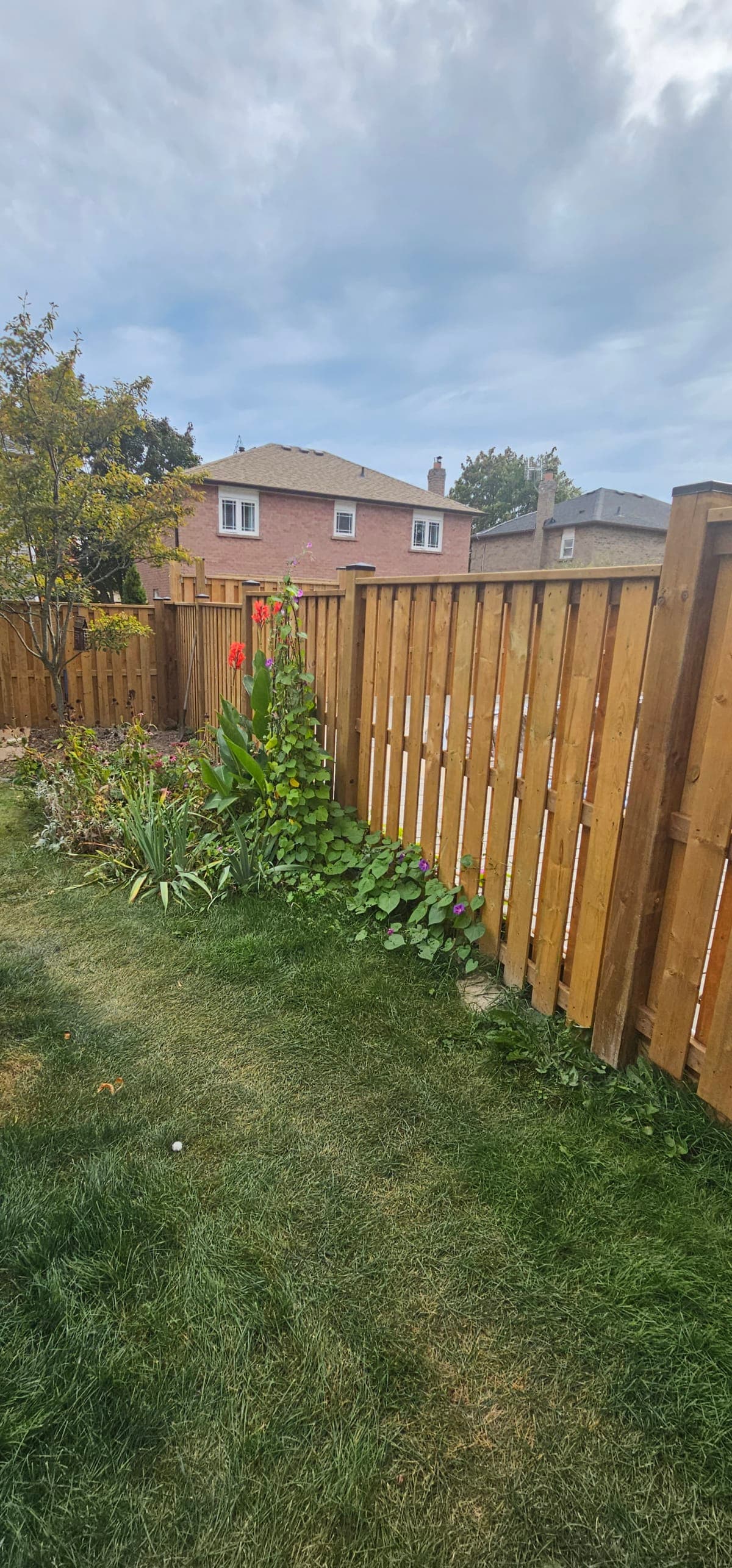
We build hundreds of fences across the GTA every year, from Brampton backyards to Vaughan new builds, Mississauga townhouse perimeters, and Toronto infill lots. Wrong lumber and fasteners is the number-one cause of early fence failure we see. Not poor installation. Not bad design. Wrong materials.
This guide is what we hand to homeowners before we start a project. It covers wood species, fastener grades, 2026 pricing in Canadian dollars, Toronto bylaw requirements, and the questions we get asked most on job sites.
professional fence installation services
Key Takeaways
- ACQ pressure-treated lumber costs $8-$15 per 2x4 in 2026; cedar pickets run $3-$8 per linear foot (Canadian Wood Council, 2025).
- Hot-dipped galvanized or stainless steel fasteners are the minimum for Ontario's freeze-thaw climate.
- A fully installed 100-linear-foot fence in Toronto runs $3,500-$9,000 depending on material grade.
- Most Toronto fences under 2 metres require no permit, but corner lots and pool enclosures are different.
- Composite lumber costs more upfront but eliminates almost all seasonal maintenance.
Why Do GTA Fences Fail So Early?
Material failure accounts for roughly 60% of fence warranty calls we receive, based on our internal job records over the past three seasons. (- ATB Construction internal service records, 2023-2025.) The GTA's climate is particularly punishing: Toronto averages 130 freeze-thaw cycles per year (Environment and Climate Change Canada, 2024), and that number is higher in Brampton and Vaughan where open fields create more exposed conditions.
Water is the enemy. Every time it freezes inside a crack, it expands by roughly 9%, widening the split with each cycle. Cheap fasteners rust, stain the wood, and lose their grip as the wood swells and contracts. A fence built with the wrong materials in Mississauga will look fine in June and lean noticeably by March.
We pulled apart a six-year-old privacy fence in North York last spring that had been built with electroplated zinc screws and untreated pine boards. The screws had rusted completely through at the thread, and the boards had delaminated from the ground up. The homeowner had spent $4,200 on installation and ended up replacing the whole fence for $7,800. Choosing the right materials at the start would have extended that fence another ten years.
Citation Capsule: Electroplated zinc fasteners carry a salt-spray rating of approximately 100 hours before corrosion begins, while hot-dipped galvanized fasteners are rated to 1,000+ hours. (American Galvanizers Association, 2023.) In an Ontario climate with road-salt runoff and freeze-thaw moisture, that difference translates directly to a fence that either holds or fails within five years.
What Lumber Should You Use for a GTA Fence?
The three realistic choices for residential fence lumber in the GTA are ACQ pressure-treated wood, cedar, and composite. Redwood and tropical hardwoods like Ipe are occasionally specified, but import costs make them impractical for most Toronto budgets in 2026.
ACQ Pressure-Treated Pine or Spruce
ACQ stands for alkaline copper quaternary, the chemical compound forced into softwood under pressure to resist rot and insects. It replaced older CCA (chromated copper arsenate) treatments after 2004 and is now the standard for ground-contact fence posts across Ontario.
2026 GTA pricing:
- ACQ 4x4 post (8 ft): $18-$28 each at Home Depot, Rona, or local lumber yards
- ACQ 2x4 rail (8 ft): $8-$15 each
- ACQ 1x6 picket (6 ft): $4-$7 each
ACQ-treated wood is the most affordable entry point and performs well for posts because it handles direct soil contact. The downsides are real: it tends to warp, check (surface crack), and bleed a greenish tint when wet. It must be sealed within 30 days of installation, and many homeowners underestimate that maintenance step.
Cedar
Western red cedar is the most popular fence board in the GTA and for good reason. It contains natural oils that resist moisture and insects without chemical treatment. It's lighter than pressure-treated wood, which means less stress on your post footings.
2026 GTA pricing:
- Cedar 1x4 picket (6 ft): $3-$6 per linear foot
- Cedar 1x6 board (6 ft): $4-$8 per linear foot
- Cedar 4x4 post (8 ft): $22-$35 each
Cedar performs noticeably better than treated pine in freeze-thaw conditions because it's dimensionally more stable. It takes stain and paint well, and a properly sealed cedar fence in Mississauga or Vaughan can last 20-30 years. (Canadian Wood Council, 2025.) It does cost 20-40% more than ACQ lumber for boards, but the maintenance reduction often pays the gap back within eight years.
Composite Lumber
Composite fence boards combine recycled wood fibre with PVC or polyethylene resin. They don't rot, won't splinter, and don't need sealing or staining. Brands common in GTA supply chains include Trex, Fiberon, and Azek.
2026 GTA pricing:
- Composite picket or board (6 ft): $8-$18 per linear foot
- Composite posts and rails: typically purchased as system packages, $120-$280 per panel section
The upfront cost is high, roughly double cedar and triple ACQ. But if you're building a fence on a Brampton rental property or a Vaughan commercial lot where annual maintenance isn't realistic, composite pays for itself. Many composite products carry 25-year warranties against fading and cracking. (Trex Company, 2025.)
composite fencing options and project gallery
Lumber Comparison Table: ACQ vs Cedar vs Composite
| Feature | ACQ Pressure-Treated | Western Red Cedar | Composite |
|---|---|---|---|
| 2026 board cost (per LF) | $2-$5 | $4-$8 | $8-$18 |
| Post cost (4x4 x 8 ft) | $18-$28 | $22-$35 | N/A (system) |
| Expected lifespan (GTA) | 10-15 years | 20-30 years | 25-30 years |
| Maintenance (annual) | Seal/stain every 2-3 yrs | Seal/stain every 3-5 yrs | Wash only |
| Ground contact suitability | Excellent (required) | Good (UC4B rating) | Not recommended |
| Freeze-thaw performance | Moderate | Good | Excellent |
| Warping/checking risk | High if unsealed | Low-moderate | Very low |
| Typical look | Utilitarian, green tint | Natural warm grain | Uniform, modern |
| 100 LF installed (Toronto) | $3,500-$5,500 | $5,000-$7,500 | $7,000-$9,000 |
Which Fasteners Hold Up in Ontario Winters?
Fasteners are where budgets get cut and fences get ruined. We see it constantly. A homeowner spends properly on cedar boards and then uses electroplated screws from a bulk bin. Two winters later, rust streaks run down every board and half the screws have backed out.
Understanding Fastener Coatings
The corrosion resistance of a fastener comes down to its coating or base metal. Here's how the common options rank for GTA conditions:
Electroplated zinc (bright zinc): The cheapest option and the worst choice for outdoor use in Ontario. The coating is thinner than 0.0003 inches and begins corroding within one to two seasons. (American Galvanizers Association, 2023.) Never use these on a fence.
Hot-dipped galvanized (HDG): The coating is applied by dipping the fastener in molten zinc. The layer is 15-20 times thicker than electroplated zinc. HDG screws and nails are the minimum acceptable standard for fence work in the GTA. They're widely available at Home Depot, Rona, and Timber Mart locations across Toronto, Mississauga, and Brampton.
Stainless steel (Type 304 or 316): No coating, just the base metal. Type 304 handles most residential applications. Type 316 is the marine-grade option and overkill for most GTA fences unless you're near Lake Ontario waterfront. Stainless costs roughly 3-5 times more than HDG but eliminates corrosion entirely for the life of the fence.
Nails vs Screws
We stopped using nails for fence boards about eight years ago. Screws have roughly 40% higher withdrawal resistance than nails in the same wood species (American Wood Council, 2023), which matters enormously when a fence panel is catching wind load or seasonal wood movement pulls at the joint. A screw grips mechanically; a nail relies on friction.
For posts and rails where structural load matters, use structural screws (GRK, Spax, or equivalent) rated for pressure-treated lumber. For pickets and boards, 2.5-inch to 3-inch coarse-thread deck screws work well. Always pre-drill near board ends to prevent splitting, especially in cedar.
Fastener Comparison Table
| Fastener Type | Corrosion Resistance | Best Use | Approx Cost (per lb, 2026 GTA) |
|---|---|---|---|
| Electroplated zinc | Very low (100 hrs salt spray) | Indoor only | $3-$5 |
| Hot-dipped galvanized | High (1,000+ hrs salt spray) | All exterior fence work | $8-$14 |
| Stainless steel 304 | Excellent (no rust) | Cedar/composite, premium builds | $18-$28 |
| Stainless steel 316 | Superior (marine-grade) | Waterfront or coastal exposure | $25-$38 |
| Structural screws (GRK/Spax) | High (proprietary coating) | Post-to-rail structural connections | $12-$20 |
Citation Capsule: Hot-dipped galvanized fasteners have a zinc coating thickness of 45-85 microns, compared to 5-8 microns for electroplated alternatives. (American Galvanizers Association, 2023.) In GTA freeze-thaw conditions with road-salt runoff, that coating difference is the primary factor separating a fence that holds for 20 years from one that needs re-fastening in year three.
What Do Toronto Fence Permits Actually Require?
Toronto fence bylaws are more specific than most homeowners expect, and the rules differ meaningfully between Toronto proper and surrounding municipalities like Mississauga, Vaughan, and Brampton.
Toronto Fence Bylaw Basics
Under Toronto Municipal Code Chapter 447, a residential fence does not require a building permit as long as it meets these conditions: (City of Toronto, 2024.)
- Maximum height of 2.0 metres (about 6.5 feet) in rear and interior side yards
- Maximum height of 1.0 metre in front yards (facing a street)
- The fence is on private property, not straddling a property line without a fence-line agreement
Pool enclosures are a different category entirely. The City of Toronto requires a building permit for any fence that forms part of a pool enclosure under the Swimming Pool Enclosure By-law. The fence must reach a minimum height of 1.52 metres, include a self-closing, self-latching gate, and have no climbable horizontal members below 1.07 metres. (City of Toronto, 2024.)
How GTA Municipalities Differ
- Mississauga: Fence permit required for any structure exceeding 2.0 metres; pool enclosures require permit and inspection regardless of height. (City of Mississauga, 2024.)
- Vaughan: Follows Ontario Building Code for pool enclosures; residential fences under 1.8 metres are generally permit-exempt but a zoning check is recommended in newer subdivisions.
- Brampton: Similar to Mississauga; any fence on a corner lot or adjacent to a driveway sight triangle requires a zoning review before installation.
Always call your municipality or check their online portal before breaking ground. A bylaw officer visit mid-build is not a situation anyone wants.
permit assistance and project management services
How Much Does a Fence Cost in Toronto and the GTA in 2026?
A fully installed 100-linear-foot privacy fence in the Toronto and GTA market runs between $3,500 and $9,000 depending on material grade, lot conditions, and whether demolition of an old fence is included.
Here's how that breaks down by material:
ACQ pressure-treated fence (100 LF, 6 ft privacy):
- Materials: $1,200-$2,000
- Labour and installation: $1,800-$2,800
- Old fence removal (if applicable): $400-$700
- Total installed: $3,500-$5,500
Cedar fence (100 LF, 6 ft privacy):
- Materials: $2,000-$3,500
- Labour and installation: $1,800-$2,800
- Old fence removal (if applicable): $400-$700
- Total installed: $5,000-$7,500
Composite fence (100 LF, 6 ft privacy):
- Materials: $3,500-$5,500
- Labour and installation: $2,000-$3,200
- Old fence removal (if applicable): $400-$700
- Total installed: $7,000-$9,000
These ranges reflect 2026 GTA labour rates and current lumber prices at Toronto-area suppliers. (Statistics Canada Building Permits Survey, Q1 2026.) Prices are higher in central Toronto where site access is tighter and parking costs for trade crews add overhead. Suburban Brampton and Vaughan projects typically come in at the lower end of these ranges.
Frequently Asked Questions
Can I mix cedar boards with pressure-treated posts and rails?
Yes, and we actually recommend it. Pressure-treated posts handle ground contact far better than cedar in most soil conditions. Use ACQ-treated 4x4 posts set in concrete, ACQ 2x4 rails, and cedar pickets for the visible boards. The combination gives you the rot resistance of treated wood where it matters (below grade) and the appearance and stability of cedar where you see it. Make sure all fasteners are hot-dipped galvanized or stainless to avoid reaction between ACQ's copper content and lesser metals.
How deep should fence posts be set in the GTA?
A standard rule for Ontario is one-third of the post length below grade, plus 6 inches of gravel drainage at the bottom. For a 6-foot fence using 8-foot posts, that means roughly 2.5-2.7 feet below grade, which gets you safely below the Toronto frost line of approximately 1.2 metres (4 feet). (Ontario Building Code, 2024.) We typically set posts 800-900 mm below the concrete collar in most GTA conditions to account for frost heave.
Do I need to call Ontario One Call before installing fence posts?
Absolutely, and this is non-negotiable. Ontario One Call (formerly Ontario Underground Infrastructure Notification System) requires anyone excavating to submit a locate request at least 3 business days before digging. (Ontario One Call, 2025.) Fence posts go into the ground, and hitting a gas line or telecoms cable is a serious safety and liability event. The locate service is free. Call 1-800-400-2255 or submit online.
How long does a cedar fence last in Toronto's climate?
A properly built cedar fence in the GTA lasts 20-30 years with maintenance every 3-5 years. (Canadian Wood Council, 2025.) The key variables are: whether the posts are cedar or ACQ-treated (treated posts last longer in ground contact), whether the fence was sealed within 60 days of installation, and whether fasteners were hot-dipped galvanized or stainless. Cedar fences that fail early almost always had one of three problems: untreated pine posts, electroplated fasteners, or no sealant applied in year one.
What's the best wood sealant for cedar fences in Ontario?
Oil-based penetrating sealants outperform film-forming (paint-like) products on cedar in Ontario's climate. Brands we use regularly on GTA fence projects include Armstrong Clark, TWP (Total Wood Preservative), and Ready Seal. Apply within 30-60 days of installation while the wood is still accepting moisture, and reapply when water stops beading on the surface, typically every 3-5 years. Avoid clear sealants if your fence gets direct afternoon sun; a lightly tinted semi-transparent stain adds UV protection that clear products don't provide.
The Bottom Line on GTA Fence Materials
Choosing lumber and fasteners isn't the exciting part of a fence project. It's also where most fences go wrong.
If you're building in Toronto, Mississauga, Vaughan, or Brampton, the climate gives you no margin for material shortcuts. The freeze-thaw cycles are real, the salt runoff from winter roads reaches fences within 30 feet of a street, and the building season is short enough that you want the fence to last as many years as possible before you're doing this again.
Our standard recommendation for most GTA homeowners: ACQ posts set in concrete, cedar rails and boards, hot-dipped galvanized structural screws for the framing, and stainless deck screws for the pickets. Seal within 60 days. Budget $5,000-$7,500 for 100 linear feet installed. That combination gives you 20-plus years of reliable performance without constant maintenance.
If budget is tight, go ACQ throughout with HDG fasteners and seal religiously. If budget isn't the constraint and you want zero maintenance, composite is worth pricing out.
What we'd steer you away from in every case: electroplated fasteners, untreated lumber anywhere below the top rail, and any wood species marketed as "treated" that doesn't carry an AWPA UC4B or UC4C rating for ground contact.
Tags
Related articles
Why Most Porch Builds Fail After Two Winters and How to Stop It
Most porches that fall apart after two winters share the same issues: frost heave and wood rot. Here's what you need to know to build a porch that lasts through Canada's wet, cold seasons.
Get Your Deck Done Right Before Toronto's Mud Season Hits
Toronto and GTA homeowners who book their deck build in early spring avoid permit delays, contractor shortages, and October mud. Here's the exact timeline and 2026 pricing to plan it right.
3 Big DIY Mistakes When Building a Pergola or Gazebo in Toronto
We get called in to fix DIY pergolas and gazebos across Toronto every summer. These three mistakes account for 80% of the tear-outs — and they're all avoidable.