Retaining Walls in Toronto: The Complete GTA Homeowner's Guide (2026)
Toronto's freeze-thaw cycles destroy poorly built retaining walls fast. Learn materials, permits, costs, and drainage rules for GTA retaining walls that actually last.
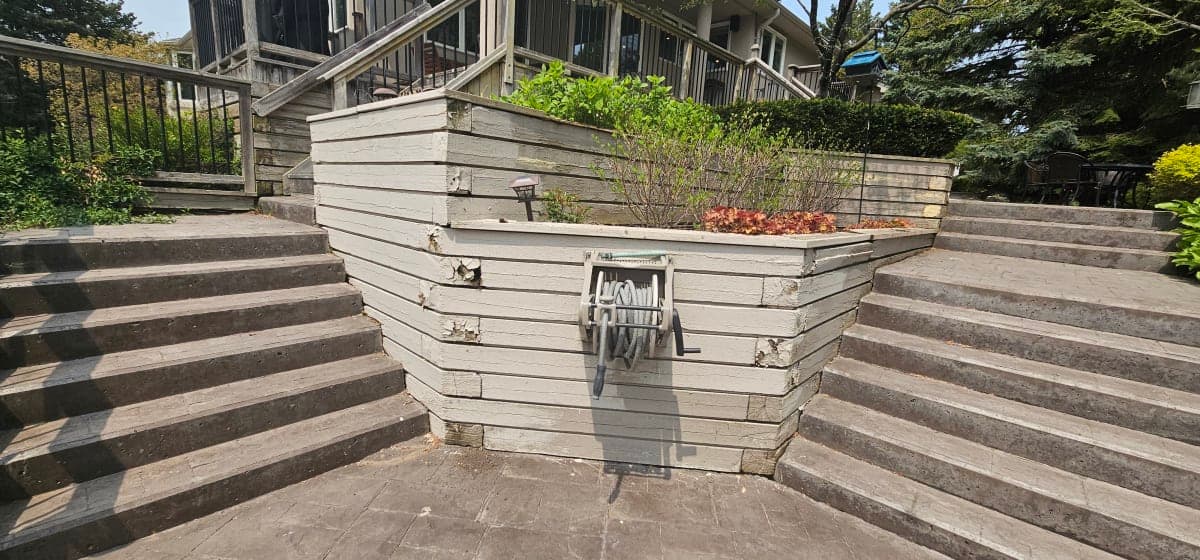
We've built retaining walls across Toronto's hilly terrain for years. Here's what makes them fail and what makes them last. In the GTA, a retaining wall isn't just landscaping. It's structural engineering that has to survive freeze-thaw cycling, clay-heavy soil, and spring melt pressure that can crack a poorly drained wall in a single season.
Key Takeaways
- Toronto walls over 1 metre require a building permit from the Toronto Building Division.
- Ontario Building Code sets frost depth at 1.2 m for the GTA — footings must go below this.
- Professional retaining walls cost $150–$350 per linear foot in Toronto depending on material and height.
- Drainage is the single biggest cause of retaining wall failure in GTA climates.
- Concrete block and natural stone outperform pressure-treated timber over a 20-year horizon in Toronto's climate.
Why Do Retaining Walls Fail So Fast in the GTA?
Toronto's climate is harder on retaining walls than most Canadian cities. The GTA averages 34 freeze-thaw cycles per year (Environment and Climate Change Canada, 2024 climate normals), and the underlying soil is predominantly Leda clay, which swells when saturated and contracts sharply when dry. A wall that handles these forces poorly will crack, tilt, or blow out within two to five years.
The two most common failure causes we see on GTA sites are inadequate drainage and footings set above the frost line. Water that has nowhere to go builds hydrostatic pressure behind the wall face. When that saturated backfill freezes, expansion forces multiply. A concrete block wall without weeping tile behind it can buckle under that load in a single hard winter.
In our experience, about 70% of the failed retaining walls we're called to replace in Toronto were originally built without a single metre of perforated drain pipe. The homeowner saved $400 on drainage. The tear-out and rebuild cost $8,000.
Do You Need a Permit for a Retaining Wall in Toronto?
Yes, in most cases. The Toronto Building Division requires a building permit for any retaining wall exceeding 1 metre (approximately 3.3 feet) in height (City of Toronto Building Division, 2026). Walls under 1 metre on a single residential property may not require a permit, but you still need to comply with the Ontario Building Code and any municipal drainage bylaws.
Permit applications in Toronto typically take 10–30 business days for residential retaining walls. You'll need to submit a site plan showing wall location, height, and drainage details. Walls over 1.5 metres or walls supporting surcharge loads (driveways, structures) almost always require a stamped engineer's drawing.
In Mississauga, Vaughan, and Brampton, thresholds vary slightly. Mississauga requires a permit for walls over 1 metre, matching Toronto's standard (City of Mississauga, 2026). Brampton requires permits for walls over 0.9 metres. Always confirm current requirements with your local building department before breaking ground.
What Does a Toronto Retaining Wall Permit Cost?
Permit fees in Toronto for a residential retaining wall typically run $200–$600 depending on wall length and complexity (City of Toronto Fee Schedule, 2026). That's a small fraction of what an unpermitted failed wall costs to tear out and redo. Factor permit time into your project timeline from the start.
How Deep Does a Retaining Wall Footing Need to Be in Ontario?
The Ontario Building Code sets the minimum frost depth for the GTA at 1.2 metres (Ontario Building Code, Division B, Article 9.12.2, 2024). Your footing or base course must start at or below this depth. This is non-negotiable in Toronto's climate.
On sloped lots in North York, Etobicoke, and Scarborough, we regularly encounter frost penetration reaching 1.4–1.5 metres in severe winters. We set base courses at 1.5 metres on exposed north-facing slopes as a precaution, even when the code minimum allows 1.2 metres.
Concrete block walls typically need a poured concrete footing at frost depth. Interlocking segmental block walls can use a compacted granular base if wall height stays below 900 mm, but any wall over that threshold in Toronto should have a concrete footing. Pressure-treated timber walls use treated posts or deadmen driven below frost line.
Why Frost Depth Matters More Than It Sounds
Frost heave is the primary structural threat to retaining walls in Ontario. When saturated soil freezes below your base, it expands upward with tremendous force. A wall not anchored below 1.2 metres will lift, tilt forward, and crack at the joints. Repairing frost-heaved walls almost always means full removal and rebuild.
What Materials Work Best for GTA Retaining Walls?
Material choice determines how your wall performs across Toronto's wide temperature swings. From January lows around -15°C to July highs near 30°C, the wall material goes through massive thermal stress. Here's how the main options compare:
Retaining Wall Material Comparison for Toronto Homeowners
| Material | Cost per Linear Foot (Toronto, 2026) | Expected Lifespan | GTA Climate Performance | Maintenance Level |
|---|---|---|---|---|
| Pressure-Treated Timber | $100–$175 | 10–15 years | Fair - susceptible to rot in wet clay soils | High - annual inspection, periodic replacement |
| Concrete Block (segmental) | $150–$250 | 25–40 years | Good - handles freeze-thaw well with proper drainage | Low - inspect annually, repoint occasional joints |
| Natural Stone (dry-stack or mortared) | $200–$350 | 40–75+ years | Excellent - natural drainage, high mass resists frost | Very Low - occasional stone resetting |
| Interlocking Retaining Block (e.g., Unilock, Allan Block) | $175–$300 | 30–50 years | Very Good - engineered for Canadian climate, geogrid reinforcement available | Low - check for settlement annually |
| Poured Concrete | $200–$350 | 30–50 years | Good - strong but cracks without proper expansion joints | Medium - seal cracks promptly |
| Gabion Baskets (wire and stone fill) | $100–$200 | 20–30 years | Very Good - excellent drainage, flexible in frost | Medium - inspect wire for corrosion |
All costs assume professional installation in the GTA market. DIY material-only costs run roughly 40–60% lower, but installation mistakes on retaining walls are expensive to fix.
view ATB retaining wall project gallery
Pressure-Treated Timber: The Budget Option With a Deadline
Pressure-treated timber walls are the fastest to build and the cheapest upfront. In the GTA's clay-heavy soils, however, they consistently underperform. Constant ground moisture accelerates rot even in modern ACQ-treated lumber, and the organic material gives no resistance to freeze-thaw cycling at the base. We recommend timber only for walls under 600 mm in height and in well-drained sandy soils.
Interlocking Concrete Block: Our Most-Recommended Option for Toronto
Interlocking segmental retaining block is what we install most often in Toronto, Mississauga, Vaughan, and Brampton. Brands like Unilock and Allan Block are engineered specifically for Canadian conditions. The interlocking geometry eliminates vertical joints that crack under frost pressure. Geogrid reinforcement layers, embedded every 600 mm of wall height, dramatically increase the wall's ability to resist lateral soil pressure without increasing visible wall thickness.
Natural Stone: The Premium Long-Term Investment
Dry-stack natural stone walls have been holding Toronto hillsides since before the city existed. Properly built, a natural stone wall drains passively through its own voids, handles frost without cracking, and develops structural strength over time as the stones settle. The challenge is skilled installation. Stone walls require experienced masons who understand batter (backward tilt), tie-backs, and void management. Costs range from $200–$350 per linear foot for professional stone work in the GTA.
How Much Does a Retaining Wall Cost in Toronto in 2026?
Professional retaining wall installation in Toronto costs $150–$350 per linear foot depending on material, height, and site conditions (ATB Construction project data, 2026). A typical suburban Toronto lot project, a 20-linear-foot wall at 1.2 metres height, runs $3,000–$7,000 all-in including drainage, backfill, and permit fees.
Based on our 2025–2026 project portfolio across the GTA, the average retaining wall project we complete runs approximately $6,200 for interlocking block at standard residential height, and $9,800 for natural stone work of similar dimensions. These figures include excavation, granular base, weeping tile drainage, and backfill compaction.
Several factors push costs toward the high end of the range. Difficult access (narrow lot lines in Toronto's older neighborhoods, for example) adds $500–$1,500 in labour. Walls over 1.2 metres requiring engineer stamps add $800–$2,000 in professional fees. Stepped or curved walls take significantly more labour than straight runs.
What Drives Cost Up on GTA Projects?
- Height: Every additional 300 mm of height roughly doubles the lateral soil pressure the wall must handle, requiring heavier materials and more geogrid.
- Soil type: Clay-heavy soils in much of Toronto require more aggressive drainage solutions.
- Access: Tight north Toronto laneways and Vaughan ravine lots add significant equipment and manual labour costs.
- Drainage complexity: Sites with high water tables or major grade changes need sump pits, pump systems, or extended weeping tile runs.
What Drainage System Does a Toronto Retaining Wall Need?
Drainage is not optional. Every retaining wall we build in the GTA includes at minimum a 300 mm (12-inch) layer of clear crushed stone behind the wall face and a 100 mm perforated drain pipe (weeping tile) at the base, daylit at each end or connected to a storm drainage point (Ontario Building Code, Division B, 2024).
Without this system, groundwater and snowmelt accumulate behind the wall. Hydrostatic pressure grows until something gives. Concrete blocks blow out at their midpoints. Timber walls rotate forward at the base. Mortared stone walls crack horizontally.
The Three-Layer Drainage Rule We Follow
Every wall we build uses this drainage sequence from the native soil side outward:
- Geotextile filter fabric placed directly against the native soil. This prevents clay fines from migrating into the drainage layer and clogging it over time.
- 300 mm minimum of 19 mm clear crushed stone as the drainage aggregate layer behind the wall face.
- 100 mm perforated pipe at the base of the wall within the aggregate, sloped at minimum 1% grade toward the outlet.
On sites with high water tables, especially ravine-adjacent properties in Don Mills, Etobicoke, and Scarborough, we add a sump basin and pump rather than relying solely on gravity drainage.
Can You Build a Retaining Wall Yourself in Toronto?
Short walls under 600 mm on well-drained lots are realistic DIY projects for handy homeowners. Above that height, the risk of getting it wrong rises sharply. A failed 1.2-metre retaining wall on a Toronto lot can allow soil to undermine a fence, a deck, or in the worst cases, a structure's foundation.
The real hidden risk in DIY retaining walls isn't the building, it's the permitting. An unpermitted wall that later fails creates liability complications for the homeowner. Toronto's property standard officers do issue compliance orders for failed retaining walls, and selling a property with an unpermitted structural wall can stall a real estate transaction.
For walls over 1 metre in Toronto, our recommendation is clear: hire a licensed contractor, pull the permit, and get the engineer's stamp if required. The $3,000–$5,000 in professional fees you pay is insurance against a $10,000+ rebuild and a property disclosure headache.
When Is the Best Time to Build a Retaining Wall in the GTA?
Late spring through early fall (May through October) is the optimal construction window in Toronto. The ground is fully thawed, concrete cures properly in warm temperatures, and compacted granular base achieves full density before winter loading begins. We book most of our retaining wall projects between May and September.
Building in late fall is possible if we can complete the project before ground freeze, typically before the end of November in the GTA. Never attempt to excavate frozen ground for a retaining wall footing. The apparent firmness of frozen soil is misleading. Once it thaws in spring, a base set in frozen ground will settle unevenly.
How Do You Maintain a Retaining Wall in Toronto?
The GTA's climate demands spring inspections every year. After winter, walk the full length of your wall looking for the following:
- Cracks or displaced blocks: Minor surface cracks in mortared joints are cosmetic. Horizontal cracks through a block's face or significant block displacement means structural investigation is needed.
- Forward tilt: Hold a level against the wall face. Any tilt exceeding 25 mm over a 1.2-metre height warrants a contractor assessment.
- Water pooling at the base: Standing water within 600 mm of a wall base after a rainfall suggests the drainage layer is compromised.
- Timber rot or insect activity: Probe timber walls at the soil line annually. Soft spots indicate rot penetration.
Address issues promptly. A single displaced block from a frost-heave cycle is a $200 repair. Left until the following spring, it's a $2,000 reconstruction.
Frequently Asked Questions
Do I need a building permit for a retaining wall in Toronto?
Yes, if the wall exceeds 1 metre in height. The Toronto Building Division requires a building permit for residential retaining walls over 1 metre (City of Toronto Building Division, 2026). In Brampton the threshold is 0.9 metres. Permit applications typically take 10–30 business days. Unpermitted walls that fail can create compliance orders and complicate property sales.
How deep must a retaining wall footing be in Ontario?
The Ontario Building Code requires footings below the frost line, set at 1.2 metres for the GTA (Ontario Building Code, Division B, 2024). On exposed north-facing slopes or sites with high groundwater, going to 1.4–1.5 metres provides additional protection. Footings above frost depth will heave in GTA winters and cause the wall to crack or tilt.
How much does a retaining wall cost in Toronto in 2026?
Professional installation runs $150–$350 per linear foot depending on material and height. A typical 20-foot interlocking block wall in Toronto costs $3,000–$6,000 installed, including drainage and permit. Natural stone projects in the same footprint run $4,000–$7,000. Add $800–$2,000 for an engineer's stamp if the wall exceeds 1.5 metres or supports a surcharge load.
What is the best retaining wall material for Toronto's climate?
Interlocking concrete block and natural stone outperform all other materials in GTA conditions. They handle freeze-thaw cycling, resist hydrostatic pressure when properly drained, and carry lifespans of 30–75 years. Pressure-treated timber degrades faster in Toronto's clay soils and moisture levels. We do not recommend timber for primary retaining walls over 600 mm in the GTA.
How do I stop my retaining wall from leaning or cracking?
The root cause is almost always drainage failure or footings set above frost depth. Ensure 300 mm of clear crushed stone behind the wall face, a perforated drain pipe at the base, geotextile filter fabric between native soil and drainage aggregate, and footings starting at minimum 1.2 metres below grade. Walls built with these elements in place rarely fail structurally in normal GTA conditions.
Choosing the Right Contractor for a GTA Retaining Wall Project
Not every landscaping contractor has the structural knowledge to build a retaining wall that will survive Toronto winters. Ask any contractor you're considering for the following before signing:
- Do they pull permits for walls over 1 metre? (If not, walk away.)
- Can they provide references for completed walls in the GTA that are at least 3 years old?
- Do they include a detailed drainage plan in their quote?
- Do they have WSIB coverage and $2 million general liability insurance?
A quality contractor will answer all four questions confidently and in writing. Their quote should itemize excavation, granular base, drainage materials, wall materials, and backfill separately so you can compare apples to apples with other bids.
get a free retaining wall quote from ATB
The Bottom Line on Retaining Walls in Toronto
Toronto's climate doesn't forgive shortcuts. Thirty-four freeze-thaw cycles a year will find every weakness in a retaining wall: inadequate drainage, footings above frost line, no geotextile fabric, blocks without geogrid reinforcement. We've seen walls fail in their first winter because one of these elements was skipped to save a few hundred dollars.
The investment in a properly built retaining wall pays back through property stability, reduced erosion, and a structure that doesn't need replacing in 10 years. Budget $150–$350 per linear foot for professional installation, factor in permit time, and insist on a drainage plan before any contractor breaks ground.
If you're planning a retaining wall project in Toronto, Mississauga, Vaughan, or Brampton, we're happy to walk your site and give you a straight assessment of what the wall needs to last. No upselling. Just honest GTA contractor experience.
Tags
Related articles
Pick the Right Lumber and Fasteners for Outdoor Lighting or Pay the Price
Choosing the wrong lumber or fasteners for outdoor lighting setups can lead to costly failures. Learn what materials work best and which to avoid for lasting results.
Roofing in Toronto: Get It Done Before Mud Season Hits
The spring-to-mud-season window is the best time to replace or repair your roof in Toronto and the GTA. Learn 2026 CAD pricing, permit rules, and how to book before contractor slots fill up.
Why Most Outdoor Structures Fail After Two GTA Winters — And How to Stop It
After two winters in Toronto, the same failure patterns show up on decks, fences, and retaining walls across the GTA. Frost heave and wood rot are the culprits — and both are preventable with the right materials and build practices.